
 Timing chain kit related knowledge
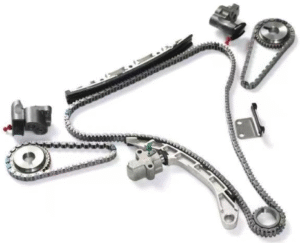
The timing chain assembly mainly consists of: timing chain, timing sprocket, timing hydraulic tensioner and timing guide rail.
Timing chain: A core component made of durable metal, it engages with the timing sprocket through chain links, connecting the engine’s camshaft and crankshaft to achieve power transmission and ensure that the opening and closing of the valves are precisely synchronized with the movement of the pistons.
Timing sprocket: Installed on the camshaft and crankshaft, it is a gear with teeth that meshes with the timing chain, transmitting the movement of the chain to the camshaft and crankshaft to control the opening and closing timing of the valve.
Tensioner: used to maintain the appropriate tension of the timing chain to prevent the chain from loosening, jumping teeth or over-stretching during operation, ensuring stable and reliable chain transmission.
Guide rail: Its function is to fix the timing chain in the appropriate position, guide the chain to run on the correct path, prevent the chain from running off or shaking, and reduce chain wear.
Main features of the timing chain kit:
Strong durability: Compared with timing belts, timing chains are more resistant to wear and high temperatures, have higher tensile strength, and are less likely to break or jump teeth.
Long duration: The consumption of the timing chain is usually very high, and it can generally run continuously for more than 100,000 kilometers. The timing chain of some vehicles can even be maintenance-free for life.
High reliability: Due to its structural and material advantages, the timing chain can maintain stable transmission performance for a long time, improving the reliability of the engine.
Importance: The timing chain is a critical engine component, ensuring the coordinated operation of all internal components. Timing chain problems, such as chain breakage, tooth skipping, or improper tension, can lead to inaccurate valve opening and closing timing, resulting in reduced engine power, decreased fuel efficiency, and engine vibration. In severe cases, this can even damage internal engine components such as pistons and valves, causing serious engine failure and significantly increasing repair costs.