
 Timing belt kit related knowledge
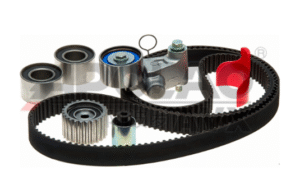
Timing belt: It is the core component of the entire engine. It connects the engine’s crankshaft and camshaft, transmits the crankshaft’s rotational motion to the camshaft, and ensures that the opening and closing of the valves are precisely synchronized with the movement of the piston, so that the various working cycles of the engine proceed in an orderly manner.
Timing tensioner: Used for belt tensioning, it allows the timing belt to maintain proper tension at all times, ensuring stable and reliable belt transmission. If the tension is too loose, the belt will slip, affecting transmission efficiency; if it is too tight, it may accelerate belt wear.
Timing idler pulley: It changes the transmission direction, increases the transmission distance and stabilizes the transmission, and assists the timing belt to better complete power transmission.
Replacement interval: It’s generally recommended to replace the timing belt every two years or every 60,000 kilometers. New vehicles generally require replacement after 60,000 to 80,000 kilometers. However, the specific replacement interval varies depending on vehicle usage, driving habits, driving environment, and other factors.
Replace the entire set: After long-term use, old parts may become worn and deformed. Mixing them with new parts may affect the proper function of the new parts and reduce the performance of the entire timing system. Therefore, it is strongly recommended to replace the entire set of parts.
Important: The timing belt is critical to the proper operation of your engine. A broken timing belt can disrupt the precise alignment of the valves and pistons, causing violent thrashing, severe engine damage, and significantly increased repair costs. Even a faulty component like the tensioner or idler pulley can result in improper belt tension or an erratic drive, impacting engine performance with reduced power output, decreased fuel efficiency, and engine vibration.